


1. Key Trade Authorities
Before diving into the legal battles, it’s important to understand the main laws and sections used to impose tariffs in the U.S.
IEEPA – International Emergency Economic Powers Act
Enacted: 1977
Purpose:
- Grants the president authority to regulate international commerce during a declared national emergency affecting national security, foreign policy, or the economy.
- Allows actions to protect national security by controlling economic transactions with foreign nations or entities that pose a threat.
- Enables economic measures aligned with U.S. foreign policy, responding to situations affecting international relations.
- Prevents economic disruptions caused by foreign threats, ensuring stability of the U.S. economy in crises.
- Provides broad powers to impose sanctions, trade restrictions, or other economic measures without prior congressional approval.
Limitations: Not intended for general trade policy; courts recently ruled many of these tariffs exceeded presidential authority due to lack of clear congressional authorization.
Section 232 – National Security Tariffs
Enacted: Trade Expansion Act of 1962
Purpose: Allows tariffs or quotas if imports threaten U.S. national security.
Examples: Steel ($29B in imports) and aluminum ($16B), up to 50% tariffs.
KeyPoint: Product-specific, legally distinct from IEEPA, and still in effect.
Section 301 – Unfair Trade Practices
Enacted: Trade Act of 1974
Purpose: Authorizes the U.S. Trade Representative (USTR) to act against countries engaging in unfair trade practices.
Use: Tariffs on Chinese goods (~$370B) for intellectual property violations.
Key Point: Targeted, country-specific, legally secure.
Section 338 – Antidumping & Countervailing Duties
- Protects U.S. industries from dumped or subsidized imports
- Example: Chinese steel sold below fair value.
- Industry-specific, requires Department of Commerce investigation.
Section 122 – Emergency Tariff Authority
- Allows temporary tariffs to protect U.S. industries from sudden import surges.
- Short-term, emergency use; legally distinct from IEEPA.
2. The IEEPA Lawsuit
Plaintiffs: Small businesses (e.g., V.O.S. Selections, MicroKits) and 13 states led by Oregon (including Arizona, Colorado, and others).
Claim: Trump’s IEEPA-based tariffs exceeded presidential authority. Congress controls trade policy, and IEEPA was not meant for broad, indefinite tariffs.
Focus: Challenged tariffs include the 10% baseline “reciprocal” tariffs and those tied to issues like fentanyl trafficking from Mexico and China. Plaintiffs argued these actions bypassed Congress, violating separation of powers.
3. Court Ruling
Appeals Court Decision: August 29, 2025 – U.S. Court of Appeals for the Federal Circuit ruled 7-4 that most IEEPA tariffs were illegal.
Major Questions Doctrine:
- Legal principle stating that when a government action has vast economic, political, or social consequences, Congress must clearly authorize it.
- Trump’s IEEPA tariffs affected billions in trade and had broad economic impact; the court found IEEPA did not provide sufficient authority.
- Ensures significant policy decisions require explicit congressional approval rather than vague emergency powers.
Temporary Stay: Enforcement paused until October 14, 2025, allowing the administration to appeal.
Impact:
- Billions in tariffs collected under IEEPA could potentially be refunded.
- Tariffs under Sections 232 (steel/aluminum) and 301 remain unaffected and could be expanded.
4. Implications of the Major Questions Doctrine
Congressional Authority: Reinforces that major government actions require clear legislative approval.
Limiting Executive Power: Prevents overreach by ensuring significant economic or policy decisions cannot be made unilaterally.
Judicial Review: Courts may require a higher standard of clarity in statutes to uphold executive actions.
Impact on Regulations: Agencies must demonstrate explicit legislative authority for major regulatory actions.
Precedent and Future Cases: Influences how courts interpret executive power and the necessity for congressional approval in significant policy matters.
5. Administration’s Defense
National Emergency Argument: Tariffs necessary to address trade deficits and protect U.S. manufacturing.
National Security: Certain imports are critical to national defense.
Executive Authority: President can act without Congress during emergencies.
Economic Warning: Overturning tariffs could disrupt trade, reduce revenue, and harm U.S. industries.
6. Economic Impacts
Revenue Generated: As of August 2025, U.S. tariff collections reached $183.1B for the year, with August alone contributing over $30B.
Projected Impact: Tariffs are projected to boost federal revenues by ~$172B in 2025 (0.57% of GDP).
7. Market Impacts
Stock Market
Short-term volatility due to uncertainty, especially in import/export-heavy sectors.
Potential beneficiaries: Manufacturing, industrials, importers, and retailers (benefit from lower costs or tariff refunds).
Affected sectors: Technology and consumer goods may see mixed effects depending on exposure to Chinese imports.
Long-term: Clearer limits on presidential tariff authority reduce policy risk and stabilize markets.
Bond Market
Treasury yields: Long-term yields rose slightly due to potential tariff refunds reducing federal revenue and increasing borrowing needs.
Corporate bonds: Sector-specific effects; firms exposed to tariffs may face slightly higher credit risk.
Investor sentiment: Short-term volatility expected; long-term stability improves if policy clarity emerges.
Commodities Market
Crude oil & natural gas: Modest upside if trade picks up and industrial activity increases.
Renewable metals (aluminum, steel, lithium): Lower costs could support solar, wind, and battery production.
Volatility: Short-term swings expected; long-term stability improves with clearer trade rules.
8. Next Steps and Updates (as of September 3, 2025)
Appeal to Supreme Court: Trump administration intends to seek expedited review; petition expected imminently.
Alternative Legal Authorities: Sections 301, 338, and 122 may allow similar tariffs legally.
Potential Refunds: If ruling holds, importers could reclaim billions in duties.
Policy Precedent: May limit presidential authority and shape U.S. trade policy for years; oral arguments could occur late 2025 or early 2026.
9. Quick Reference Table of Tariff Authorities
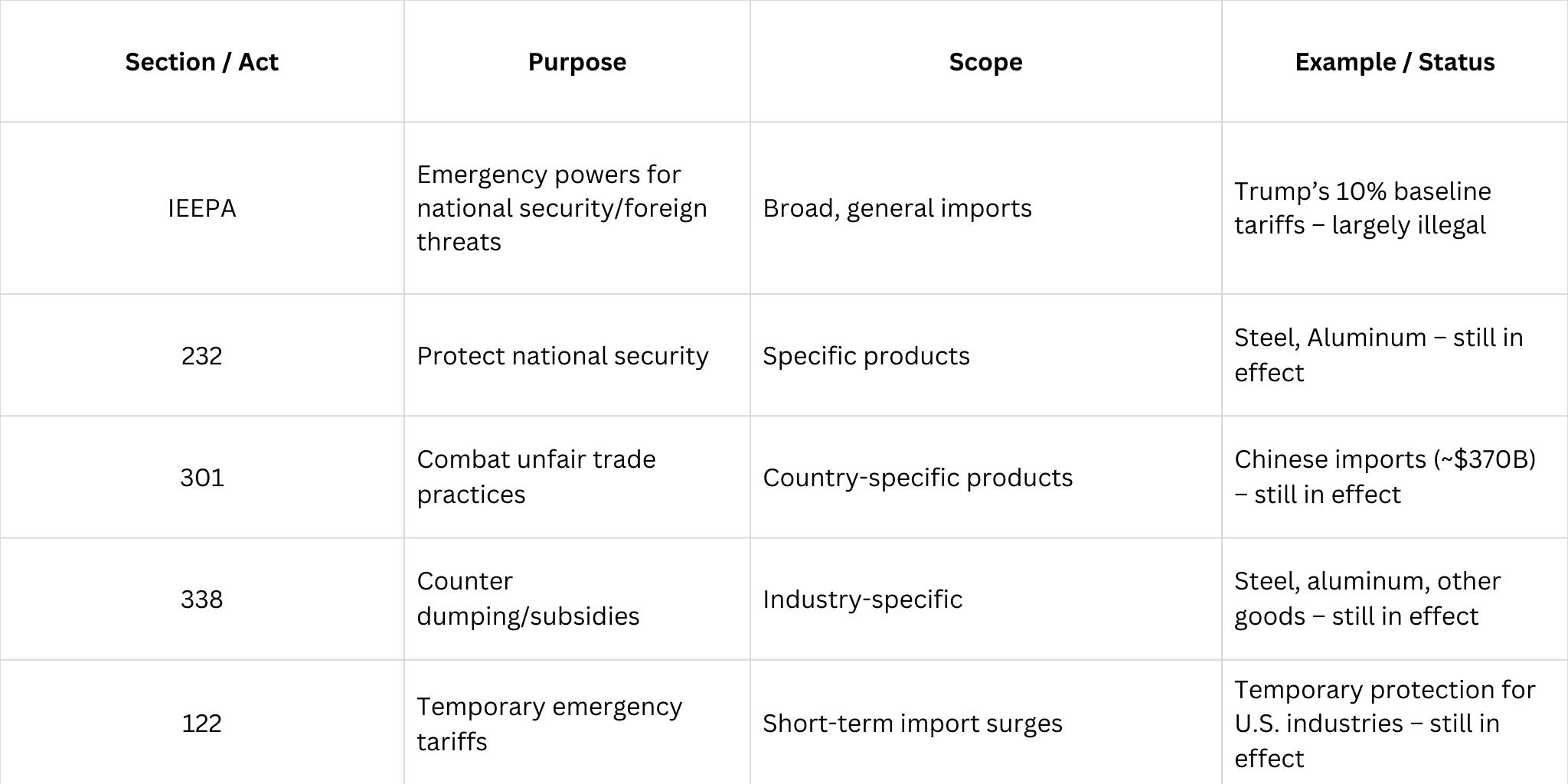
Bottom Line
- IEEPA-based tariffs are in jeopardy, with billions potentially refundable.
- Sections 232, 301, 338, and 122 remain legally secure.
- Market implications: Stocks, bonds, and commodities may experience short-term volatility, but long-term policy clarity could stabilize markets and reduce trade-related risk.
- The case could reshape presidential trade authority, influence U.S. trade policy, and affect businesses, consumers, and international relations.
The content provided herein is based on our interpretation and is not intended to be legal advice or provide a tax opinion. This information is a summary only and not meant to represent all provisions within each Section/Act.